
Une FLAMME
Class Content
In class, all mistakes are corrected until students “sound” French in terms of their pronunciation, vocabulary, sentence structure, verb conjugation, and intonation.
To help students gradually integrate the language, and based on the needs of each person, the teacher encourages them to speak, travel, watch and listen to audiovisual content, research, and interact in French.

The teacher adapts to the level and needs of each student. The areas covered in class are determined by the mistakes students make or by their questions.
Students always work on the language areas (specific structures, vocabulary, a new tense, etc.) that interest them and the areas they need at that point in time.

Beginner
Students first learn the pronunciation of all the sounds that exist in French, followed by linguistic structures with simple sentences. Students are introduced to the language by speaking before writing.
Intermediate
Students discover, practice, and gradually register the main areas of the language (structures, conjugations, general and specific vocabulary). Classes also cover more speaking and writing elements (comprehension and expression).

Advanced
Students deepen their knowledge of the French language, and classes stress oral expression (conversations, sharing opinions, etc.). Written comprehension is more complex and has more specific vocabulary.
Biblical French (optional)
Students who opt for this module will work on vocabulary, pronouncing Biblical names, prayer, Bible stories, etc. There is also the possibility to engage in Bible studies and short worship sessions, and learn Christian songs.

Class Materials:
-
small tools,
-
images,
-
texts,
-
audio and audiovisual documents
-
exercise books (based on student profile)
Refresher Courses

Students who wish to continue working on their French after completing their initial course package can take refresher courses for one to two hours per week where they can choose their areas of focus.

Online classes
The same rates apply for in-person and remote classes. A white screen and digital versions of the materials used in class will be shared with students. We use WhatsApp for video calls.
In-person classes

Classes can be held at your home or nearby, for example at the media library in your town or based on what is available.
Timetable
Timetables are flexible and personalized. Class times are defined based on your availability and wishes so they can fit into your schedule and responsibilities (for example dropping off and picking up children from school). Classes can be held from Monday to Friday, anywhere between 8:30 am and 6:00 pm, for no more than 20 hours per week. It is possible to combine remote classes with in-person classes, and to take individual classes alongside group classes.

Examples of Class Packages:
20 hours (one group)
20 hours (various groups)
16 hours
20 hours (one group)

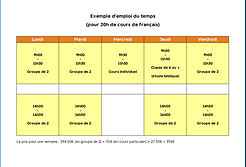

10 hours

2 hours


Breaks
Breaks will be determined with students and can follow the break schedule used for schools. Longer breaks can be taken during the summer.
2026-2027 School Break Schedule:
Start of classes
All Saints break
Christmas break
Winter break
Spring break
Summer break
September 1
October 17-November 1
December 19-January 3
February 6-21
April 3-18
starting July 3

Assessment
Each student is assessed regularly. Assessments are done remotely or in person.
-
Formative Assessments:
Every two months, students are assessed on the areas covered over the previous period.
-
Placement Assessments:
Every four months, students are assessed to determine their level.

The Council of Europe has defined six levels of foreign language acquisition.
A1
Elementary. You can introduce yourself, understand and use familiar, everyday expressions, and communicate very simply if the other person speaks slowly, clearly, and is prepared to help.
A2
Pre-intermediate. You can communicate on simple, routine tasks, share simple and direct information on familiar topics, talk about your daily life, immediate environment, and topics that correspond to your immediate needs, and understand isolated sentences and frequently used expressions from everyday life (simple personal and family information, shopping, work, etc.).
BASIC
B1
Intermediate. You are autonomous in most situations encountered while traveling in an area where the language is spoken. You can understand the main points of a discussion if the language is standard and clear, the subject matter is familiar (work, school, hobbies), and you can produce simple, coherent input on familiar topics and in your areas of interest. You can describe events and experiences, your hopes, dreams and aspirations, and briefly explain future projects and ideas.
B2
Upper intermediate. You can understand the main ideas of concrete or abstract topics in complex and even technical texts if they are in your area of specialization. You can communicate spontaneously and comfortably with native speakers. You can express yourself clearly and in detail on a wide range of topics, give your opinions on current events, present the advantages and disadvantages of various options, etc.
C1
Advanced. You can understand long, difficult texts and implicit meanings. You can express yourself spontaneously and fluently without spending much effort finding words, and can use language efficiently and easily for social, professional, and academic purposes. You can express yourself on complex topics in a clear, structured manner, showing controlled use of organizational patterns, connectors, and cohesive devices.
C2
Proficiency. You can understand virtually everything you read and hear effortlessly. You can summarize information from varying written and spoken sources, reconstructing arguments and accounts coherently. You can express yourself spontaneously, very fluently and accurately, and can clearly provide subtle nuances even in more complex situations.
INDEPENDENT
PROFICIENT
Learning duration
Each student’s case is different, and it is impossible to know how long it takes to get to a specific level.
Estimate for a group of 6 or more students at 20 hrs per week:
Full beginner → A1: around 7 weeks (140 hours).
A1 → A2: around 7 weeks (140 hours).
A2 → B1: around 14 weeks (280 hours).
B1 → B2: around 14 weeks (280 hours).
Estimate for a group of 2 to 5 students at 15 hrs per week:
Full beginner → A1: around 7 weeks (105 hours).
A1 → A2 : around 7 weeks (105 hours).
A2 → B1 : around 14 weeks (210 hours).
B1 → B2 : around 14 weeks (210 hours).
Estimate for individual classes at 10 hrs per week:
Full beginner → A1: around 7 weeks (70 hours).
A1 → A2 : around 7 weeks (70 hours).
A2 → B1 : around 14 weeks (140 hours).
B1 → B2 : around 14 weeks (140 hours).
